
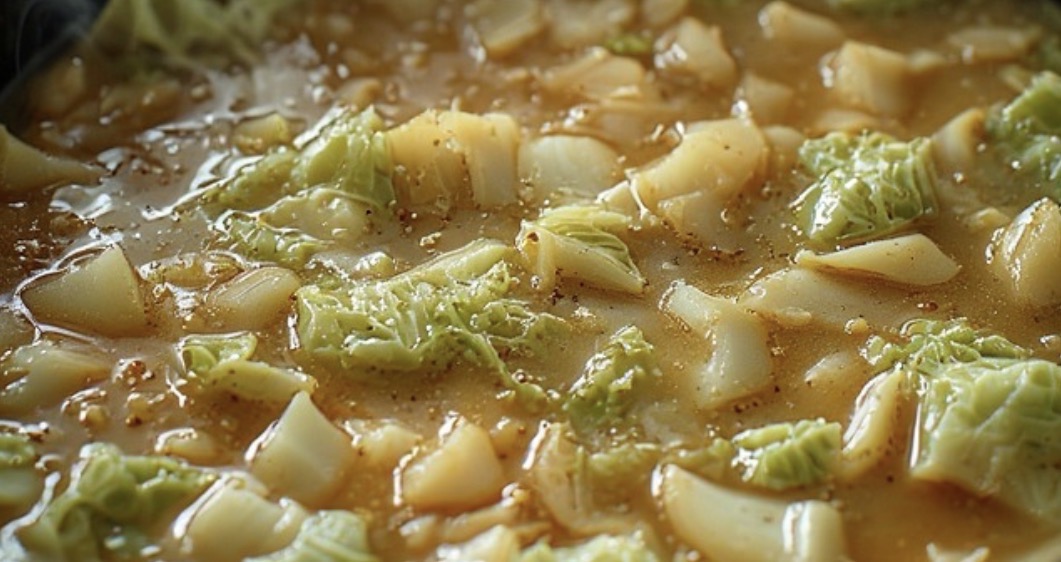
Slow Cooker Cabbage and Onion Soup
The most honest soups in the American kitchen were born out of necessity. When meat was scarce and the pantry was thin, cooks reached for what was cheapest and most available — and two of the most reliable answers were always cabbage and onions. Both are inexpensive, both keep well, both have a natural sweetness that emerges when cooked low and slow, and together in a good broth with a little fat to coax out their flavor, they produce a soup that’s surprisingly rich, deeply golden, and satisfying in a way that its four-ingredient simplicity barely hints at.
This slow cooker version is built on that same thrifty logic. Green cabbage shredded into thin ribbons, yellow onions sliced into half-moons, a generous amount of good low-sodium broth, and a tablespoon or three of butter or oil drizzled over everything before the lid goes on and the slow cooker is left alone for the better part of a day. By the time it’s done, the cabbage has turned silky and tender, the onions have practically melted into the broth, and the liquid has taken on a deep amber color and a flavor that tastes like something long and carefully made, not something assembled in ten minutes from four pantry items. That’s the quiet miracle of this style of cooking, and why soups like this one have kept showing up on family tables through lean years and comfortable ones alike.
Why Such Simple Ingredients Taste So Good
Cabbage and onions share a characteristic that makes them ideal candidates for long, slow cooking: both contain significant amounts of natural sugar beneath their sharper, more pungent raw flavors. When exposed to sustained low heat in a moist cooking environment, that sugar gradually caramelizes and the volatile compounds that make raw cabbage and raw onion sharp and slightly bitter soften and mellow. What remains after seven or eight hours in a slow cooker is the vegetable’s sweetness, extracted fully into the broth, with almost none of the assertiveness that makes some people wary of cabbage in other preparations.
The fat — butter or oil — plays a specific role that goes beyond simple flavor addition. Fat carries and distributes fat-soluble flavor compounds that water alone cannot extract from the vegetables as effectively. The droplets of melted butter or oil that coat the cabbage and onions at the start of the cook act as a flavor medium throughout the long simmer, helping to draw more of the vegetables’ aromatic compounds into the broth and giving the finished liquid that characteristic golden sheen and slight richness that distinguishes a properly made vegetable soup from a watery one. Three tablespoons is a modest amount relative to the volume of vegetables and broth, but it makes a disproportionate difference to the finished soup’s character.
Why You’ll Love This Recipe
This is about as economical as a hot, home-cooked meal gets. A head of green cabbage, three yellow onions, a carton of broth, and a few tablespoons of butter — ingredients that cost very little and are available at any grocery store year-round. The slow cooker does the work entirely unattended, which means the only real investment is the ten minutes of prep to core and slice the vegetables. The soup serves four generously and reheats so well that it actually improves by the next day as the flavors continue to develop in the refrigerator overnight.
It’s also one of the most naturally adaptable soups available. The four-ingredient base is a genuinely good soup on its own terms, and it accepts additions — rice, barley, potato, leftover ham, smoked sausage — with grace and without complication. Make it exactly as written for a pure, clean, vegetable-forward bowl, or use it as the starting point for a heartier, more varied version depending on what’s in the kitchen.
Ingredient Notes
Green cabbage — one medium head, approximately two to two and a half pounds, cored and thinly sliced — is the foundation of the soup. Green cabbage is the right choice here: its mild, slightly sweet flavor deepens considerably over the long slow cook, its firm structure holds up through the full cooking time without dissolving entirely, and it’s reliably inexpensive year-round. Core the cabbage by cutting out the dense, woody central stem before slicing — the core doesn’t soften adequately in the slow cooker’s cooking time and its texture would be unpleasant in the finished soup. Slice the remaining cabbage as thinly as possible, into narrow ribbons about a quarter inch wide, so every strand becomes fully tender and silky in the long cook. Savoy cabbage is a lovely variation — its crinkled, more delicate leaves produce a slightly more refined texture and a milder flavor in the finished soup. Napa cabbage is softer still and requires less cooking time; reduce the cook to 5 to 6 hours on LOW if using it.
Yellow onions — three large ones, peeled and thinly sliced — provide the soup’s sweetness and body. Three full onions is a generous amount relative to the other ingredients, which is exactly right: the onions are doing significant flavor work in this recipe, and their long slow cook in the broth produces a cooking liquid that tastes deeply savory and slightly sweet in a way that a smaller quantity of onion simply can’t achieve. Slice them into thin half-moons (halve through the root end, peel, then slice crosswise) for slices that soften and separate fully into the broth during cooking. Yellow onions are strongly preferred over white or sweet onions here — their sharper initial flavor and higher sulfur compound content produce a more complex, savory depth when slow-cooked than the milder alternatives. Sweet onions like Vidalia are acceptable but produce a noticeably sweeter, less savory result.
Butter or vegetable oil — three tablespoons — is the fat that carries and distributes flavor throughout the soup. Butter produces a richer, more rounded quality in the finished broth and gives it the golden, slightly silky appearance that makes the soup look as good as it tastes. Vegetable oil produces a lighter, more neutral result that keeps the soup fully vegan and is a very good alternative when dairy isn’t an option. Olive oil is another excellent choice — its mild fruitiness complements the vegetable flavors well and gives the broth a slightly Mediterranean character. Whatever fat you use, three tablespoons is the right amount to coat the vegetables adequately without making the finished soup greasy.
Low-sodium vegetable or chicken broth— six cups — forms the liquid base that the cabbage and onions cook in and that becomes the soup’s golden broth. Low-sodium broth is recommended because the vegetables themselves contribute very little sodium, and using a full-sodium broth can make the finished soup saltier than intended — particularly since the broth reduces slightly during the long cook and its salt concentrates. Vegetable broth keeps the soup fully vegetarian and vegan (with oil instead of butter) and produces a clean, vegetable-forward flavor. Chicken broth produces a slightly richer, more savory result with a greater depth of background flavor. Both are excellent; the choice depends on dietary preference and what you have available. Good-quality homemade stock makes a genuinely superior soup if you have it.
Ingredients
- 1 medium green cabbage (about 2 to 2½ lbs), cored and thinly sliced
- 3 large yellow onions, peeled and thinly sliced into half-moons
- 6 cups low-sodium vegetable or chicken broth
- 3 tbsp unsalted butter or vegetable oil
- Salt and black pepper to taste
-
Step-by-Step Instructions
Step 1 — Prep the Vegetables
Core the cabbage by placing it on a cutting board, halving it through the root end, and cutting out the dense triangular core from each half. Slice each cored cabbage half into thin ribbons, approximately a quarter inch wide. Peel the onions, halve each one through the root end, and slice into thin half-moons. The thinness of the slices matters for both vegetables — thinner slices soften more evenly and completely during the long cook, producing a silkier texture in the finished soup than thicker, chunkier pieces would.
Step 2 — Combine in the Slow Cooker
Add the sliced cabbage and onions to the slow cooker insert and toss them together loosely with your hands or a large spoon so the two vegetables are combined rather than sitting in separate layers. Drizzle the butter (melted first if using solid butter) or vegetable oil evenly over the surface of the vegetables, trying to distribute it as widely as possible. Pour the six cups of broth over the vegetables. Use a large spoon to gently press the vegetables down into the liquid so most of the cabbage and onion is submerged or at least in contact with the broth — the vegetables will cook down considerably and what seems like a very full slow cooker at the start will reduce to a manageable level within the first hour of cooking.
Step 3 — Cook Low and Slow
Cover the slow cooker and cook on LOW for 7 to 8 hours, or on HIGH for 3½ to 4 hours. The LOW setting is preferred for this soup — the longer, gentler heat gives the onions and cabbage more time to slowly sweeten and mellow, producing a more deeply developed, golden broth than the faster HIGH cook achieves. At 7 hours on LOW, both vegetables should be completely tender and silky, offering no resistance whatsoever to a spoon, and the broth should have deepened from the pale color of the raw broth to a rich amber-gold with tiny droplets of fat on the surface. The kitchen will smell very good at this point.
Step 4 — Season and Serve
Taste the soup and adjust seasoning as needed. Whether additional salt is required depends entirely on the broth you used — low-sodium broth will likely need a modest pinch of salt, while a more seasoned broth may need none at all. A few grinds of black pepper at this stage brighten the flavor considerably and are always a welcome addition. Ladle the soup into warm, deep bowls, making sure each portion gets a generous amount of the tender cabbage and soft onion strands along with plenty of the golden broth. Serve immediately.
Tips for the Best Results
Slice the vegetables thin. This is the single most important preparation step. Thin slices — particularly of the onion — soften and practically melt into the broth during the long cook, contributing their sweetness and depth uniformly throughout the soup. Thick chunks of onion or wide ribbons of cabbage will soften but won’t produce the same silky, integrated texture in the finished bowl. Take the extra time at the prep stage to slice as finely and evenly as possible.
Consider pre-softening the onions for more depth. For an even more deeply flavored broth, cook the sliced onions in the butter in a wide skillet over medium heat for 15 to 20 minutes, stirring occasionally, until they’re lightly golden and beginning to caramelize, before adding them to the slow cooker. This optional step develops browning compounds in the onions — through the Maillard reaction — that don’t form in the slow cooker’s moist heat environment, and the resulting broth is noticeably more complex and savory. It adds time to the prep but transforms the soup from excellent to exceptional. Transfer the softened onions and any butter from the pan directly to the slow cooker, add the cabbage and broth, and proceed as directed.
Don’t pack the vegetables too tightly.Pressing the vegetables down into the broth gently is fine and necessary; compressing them into a dense mass is not. A little looseness in the slow cooker insert at the start allows the heat and liquid to circulate more freely through the vegetables, producing more even cooking throughout the pot.
Use good broth. In a four-ingredient soup where the broth is one of the four, its quality is directly perceptible in every spoonful. Good-quality low-sodium vegetable or chicken broth makes a notably better finished soup than a lower-quality option. Homemade stock, if you have it, elevates the soup significantly.
Taste and season at the end, not before. The vegetables release liquid as they cook and the broth concentrates slightly over the long simmer, which means the seasoning level at the beginning of the cook will be different from the seasoning level when the soup is done. Always taste and adjust salt at the end of the cooking time, not at the start.
Frequently Asked Questions
Can I make this soup fully vegan?
Yes, very easily. Use vegetable broth rather than chicken broth, and use vegetable oil or olive oil in place of the butter. Every other ingredient in the recipe is already plant-based. The resulting soup is fully vegan and loses nothing of its essential character from the substitutions.
Can I add meat or protein?
Yes — this is one of the most natural and time-honored variations. A ham bone or leftover ham hock nestled into the slow cooker with the vegetables at the beginning of the cook produces a rich, smoky depth in the broth that’s particularly good; use water in place of the broth since the ham bone will create its own flavorful stock. Sliced smoked sausage added to the pot in the last hour of cooking adds substance and a savory, slightly smoky quality. Diced leftover cooked chicken or white beans stirred in for the final 30 minutes turns the soup into a more substantial one-bowl meal. Any of these additions works without changing the fundamental character of the dish.
Can I add other vegetables?
Yes. Diced potato added with the cabbage and onions at the beginning of the cook breaks down partially during the long simmer, releasing starch that thickens the broth slightly and gives it a creamier body — a Midwest-style variation that’s particularly warming in cold weather. Diced carrots added at the start add sweetness and color. Sliced celery is a traditional soup base addition that deepens the broth’s savory quality. All of these work naturally within the spirit of the recipe.
Can I make this on the stovetop?
Yes. Soften the onions in the butter or oil in a large pot over medium heat for 10 to 15 minutes until they’re translucent and beginning to soften. Add the cabbage and stir to combine. Pour in the broth, bring to a boil, then reduce to a gentle simmer, cover, and cook for 45 minutes to an hour until the cabbage is completely tender and the broth has deepened in color. The stovetop version is faster but produces a slightly less sweet, less deeply developed result than the slow cooker version. Both are very good.
How do I store and reheat leftovers?
Store leftover soup in an airtight container in the refrigerator for up to 5 days. The soup thickens slightly during storage as the starch from the vegetables leaches further into the broth — this is normal and the consistency can be adjusted with a splash of additional broth when reheating. The flavor improves noticeably overnight as the vegetables and broth continue to exchange flavors in the refrigerator. Reheat gently on the stovetop over medium-low heat, stirring occasionally, or in the microwave in short bursts with a cover over the bowl. This soup also freezes well for up to 3 months; thaw overnight in the refrigerator and reheat as above.
Variations Worth Trying
Barley and cabbage soup: Stir a third to a half cup of pearl barley into the slow cooker at the beginning of the cook along with the vegetables. The barley absorbs the broth and becomes plump and chewy during the long cook, and the starch it releases thickens the broth into a more substantial, stew-like consistency. This version is particularly filling and warming and is one of the most satisfying cold-weather soups available from a short ingredient list. Add an extra cup of broth to account for the barley’s absorption.
Smoky ham and cabbage soup: Nestle a leftover ham bone or a smoked ham hock into the slow cooker with the cabbage and onions and reduce the broth to four cups, topping up with water. The bone releases its smoky, savory richness into the broth during the long cook, producing a deeply flavored, slightly smoky soup with a complexity that takes the dish well beyond its ingredient count. Remove the bone before serving, shred any meat from it, and stir the meat back into the soup. This is the variation that most closely echoes the Depression-era original spirit of the recipe.
Creamy cabbage and onion soup: In the final 30 minutes of cooking, stir in half a cup of heavy cream or full-fat coconut cream. The cream softens the soup’s savory edge into something richer and more soothing, with a velvety quality that makes each bowl feel more indulgent. A few tablespoons of cream cheese, broken into small pieces and stirred in at the same stage, melts into the broth and adds a tangy, creamy richness that’s particularly good.
German-style cabbage soup: Add a teaspoon of caraway seeds, a tablespoon of apple cider vinegar, and a teaspoon of light brown sugar to the pot along with the broth at the beginning of the cook. These additions give the soup a distinctly Central European character — the caraway’s slightly anise-like warmth, the vinegar’s brightness, and the sugar’s caramelizing sweetness working together to produce a broth that’s complex and deeply satisfying. A slice of dark rye bread alongside is the ideal accompaniment for this version.
Rice and cabbage soup: Stir a cup of cooked white or brown rice into the finished soup during the last 20 minutes, allowing it to heat through and absorb some of the golden broth. The rice makes the soup substantially more filling and adds a comforting, porridge-like quality to each bowl that’s particularly welcome on cold days. Alternatively, add a quarter cup of uncooked white rice to the slow cooker at the start of the cook — it will dissolve partially into the broth, thickening it naturally and creating a heartier consistency throughout.
Serving Suggestions
This soup is best served in wide, deep bowls with something alongside for dipping into the golden broth. Thick slices of crusty bread — sourdough, a good country loaf, or a baguette — are the most natural accompaniment and essential for capturing the broth that remains in the bowl after the vegetables are eaten. Buttered toast achieves the same effect with less ceremony. A grilled cheese sandwich or a sharp cheddar sandwich served alongside turns the soup into a complete, substantial meal. A simple green salad or a plate of sliced apples provides a fresh, crisp counterpoint to the warmth and richness of the soup. Black pepper ground at the table over each bowl is the finishing touch the soup benefits from most — a few grinds over the surface add fragrance and a gentle heat that brightens the whole bowl.
Storage
This soup stores beautifully and is one of those dishes that genuinely improves after a day in the refrigerator, when the flavors have had more time to develop and the broth has deepened further. Store in an airtight container for up to 5 days and reheat gently with a splash of broth or water added to restore the original consistency. The soup freezes well for up to 3 months — thaw overnight in the refrigerator and reheat on the stovetop for the best result.
Old-Fashioned Wisdom, One Bowl at a Time
Slow Cooker Cabbage and Onion Soup is a reminder that the most satisfying food doesn’t require many ingredients or elaborate technique. It requires good vegetables, enough time, and the patience to let the slow cooker do what it does best — drawing out flavors gently over hours until what started as two ordinary pantry vegetables in plain broth becomes something golden, silky, and genuinely nourishing. That’s the wisdom that generations of cooks understood before we had long ingredient lists and complicated methods to rely on, and it’s wisdom that still holds.
Enjoy!